Art for the Nation Collecting for a New Century National Gallery of Art Washington 20002001


The National Gallery (German: Nationalgalerie ) in Berlin, Frg, is a museum for art of the 19th, 20th and 21st centuries. It is part of the Berlin Land Museums. From the Alte Nationalgalerie, which was built for it and opened in 1876, its exhibition space has expanded to include five other locations. The museums are role of the Berlin Country Museums, owned by the Prussian Cultural Heritage Foundation.
Locations [edit]
The holdings of the National Gallery are currently shown in five locations:[ane]
- Alte Nationalgalerie: 19th-century art, on Museum Island
- Neue Nationalgalerie: 20th-century art, at the Kulturforum. The building, designed past Ludwig Mies van der Rohe, opened on 15 September 1968.[ii]
- Berggruen Museum: in Charlottenburg, showing classics of 20th-century mod art collected by Heinz Berggruen; added to the National Gallery in 1996.[3]
- Scharf-Gerstenberg Collection: in Charlottenburg, showing 20th-century fine art from French Romanticism to Surrealism; added to the National Gallery in 2008.[4] [5]
- Hamburger Bahnhof: Museum für Gegenwart, contemporary fine art; added to the National Gallery in 1996.[3]
- Friedrichswerder Church: 19th-century sculpture, a church designed past Karl Friedrich Schinkel, opened as an annexe of the National Gallery in September 1987.[six] [7] In 2012 the building was closed indefinitely attributable to structural harm.[8]
History [edit]
Planning, foundation and construction of the original building [edit]
There was long discussion of the desirability of establishing a national gallery in Berlin,[9] particularly during the period of revolutionary nationalism around 1848, and it became an increasingly serious proposition from 1850, when publications appeared advocating it.[10] From the start it was bound upwardly with the ambitions of Prussia and the wish for Berlin to become a capital of world renown.[xi] The determination was finally taken in 1861, after the death of the banker and art patron Joachim Heinrich Wilhelm Wagener, who bequeathed his all-encompassing drove (262 artworks) to the then Prince Regent, the future King William I, in the hope of catalysing the germination of a gallery of "more recent" art.[10] [12] [13] [14] The collection was initially known as the Wagenersche und Nationalgalerie (Wagener and National Gallery) and was housed in the buildings of the Prussian University of Arts.[15]
Friedrich August Stüler began working on a design for a gallery edifice in 1863, based on a sketch by William I's begetter, King Frederick William IV of Prussia.[16] Two years and two failed plans later, his third proposal was finally accepted. Stüler died earlier planning was completed and Carl Busse handled the remaining details in 1865. In 1866, by social club of the male monarch and his cabinet, the Kommission für den Bau der Nationalgalerie (Commission for the structure of the national gallery) was created.[17] Basis was broken in 1867 nether the supervision of Heinrich Strack. In 1872 the structure was completed and interior work began. The opening took place on March 22, 1876 in the presence of William I, who was past then German Emperor.[18]
The building, today the Alte Nationalgalerie, resembles a Greco-Roman temple (a form chosen for its symbolism that, it has been pointed out, is not well suited to displaying art)[xix] and is stylistically a combination of belatedly Classicism and early Neo-Renaissance. It was intended to limited "the unity of art, nation, and history", and therefore has aspects reminiscent of a church building (with an apse) and a theatre (a grand staircase leading to the entry) also as a temple. An equestrian statue of Frederick William Four tops the stairs, and the inside stairs have a frieze by Otto Geyer depicting German history from prehistoric times to the 19th century.[16] The inscription over the door reads "To High german art, 1871" (the yr of the founding of the Empire, non the year the gallery was completed).[xx] [21] On his get-go visit to Berlin, in Nov 1916, the young Adolf Hitler sent a postcard of this building to a comrade in arms to congratulate him on receiving the Iron Cross.[22]
Until 1933 [edit]
The first manager of the National Gallery was Max Jordan, who was appointed in 1874, before the building was completed.[13] When the building opened, in addition to Wagener'south drove, information technology independent over seventy cartoons for friezes on mythological and religious subjects by Peter von Cornelius; high-ceilinged galleries were designed to conform them.[20] Wagener's collection was not express to High german fine art; in particular, information technology included Belgian artists who were popular at the time; and under Hashemite kingdom of jordan the gallery'southward holdings speedily came to include an unusually large drove of sculpture and a drawings section.[twenty] However, Hashemite kingdom of jordan was hampered throughout his tenure by the Regional Art Committee, which was made up of representatives of the academic fine art institution and resisted all attempts to larn modernist art.[23]
In 1896, he was succeeded as managing director past Hugo von Tschudi, formerly banana head of the Berlin museums under Wilhelm von Bode.[23] Although he had previously had no clan with modern art, he was fired with enthusiasm for Impressionism on a visit to Paris where he was introduced to the fine art dealer Paul Durand-Ruel, and became determined to learn a representative collection of Impressionist fine art for the National Gallery. When the commission vetoed his requests, he secured the patronage of a large number of wealthy bourgeois art collectors, most of them Jewish.[24] He likewise rearranged the exhibition spaces, putting many items in storage to brand room for works by Manet, Monet, Degas and Rodin likewise as the earlier Constable and Courbet. 1 of the first, presently later Tschudi took upwardly the post, was Manet's In the Solarium;[25] in 1897, the Berlin National Gallery became the outset museum in the world to acquire a painting by Cézanne.[26] This moved the gallery decisively away from emphasis on Prussia and the rest of the High german Empire. In response to complaints from the academic connoisseurs, William II decreed in 1899 that all acquisitions for the National Gallery must have his personal authorization; Tschudi initially complied and rehung the old works, but the royal prescript proved unenforceable, prompting the Kaiser to build public monuments to his power instead. In 1901, at the inauguration of the memorials on the Siegesallee, he gave a spoken language denouncing "gutter art" which became known equally the Rinnsteinrede (gutter spoken language).[24] [27] [28]
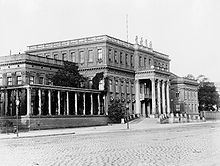
Tardily 19th-century view of the Crown Prince's Palace, which became the National Gallery'southward annexe for modern fine art in 1919
Tschudi also had a great appreciation for the High german Romantics, many of whose paintings were included in Wagener's original bequest.[25] [29] An exhibition of 100 years of German art at the National Gallery in 1906 contributed to reawakening involvement in artists such every bit Caspar David Friedrich.[29] This was also an interest shared past Tschudi'south successor, Ludwig Justi, who was manager from 1909 to 1933 and added to the gallery's holdings in early on 19th-century German painting.[29]
In 1919, after the abolition of the Prussian monarchy, the gallery acquired the Crown Prince'southward Palace (Kronprinzenpalais) and used it to display the modern art. This became known every bit the Neue Abteilung (New Department) or National Gallery 2, and met the demand by contemporary artists for a Gallery of Living Artists.[30] [31] [32] It opened with works by the Berlin Secessionists, the Impressionists and the Expressionists.[33] This was the commencement state promotion of Expressionist works, which were unpopular with large numbers of the public,[34] but the collection was, in the sentence of Justi'south assistant Alfred Hentzen, superior to that of all other German galleries so collecting modern fine art.[35] By far the largest share of artworks in the 1937 exhibition of 'Degenerate Art' under the Nazis were taken from this collection.[36]
Nazi Frg [edit]
Justi was one of 27 art gallery and museum heads forced out by the Nazis in 1933 under the Police for the Restoration of the Professional Ceremonious Service, to be succeeded for a few months by Alois Schardt[37] and and so by Eberhard Hanfstaengl, who was in plow dismissed in 1937;[38] he had refused to meet with the committee nether Adolf Ziegler, president of the Reich Chamber for the Visual Arts, who were charged with purging the gallery of "degenerate" works. Some artwork from a dealer had been burnt in the furnaces of the National Gallery building in 1936,[36] [39] and the modern fine art annexe in the Crown Prince'south Palace was shut downward in 1937 as a "hotbed of cultural Bolshevism".[31] [40] [41] The gallery was placed under the control of the Berlin State Museums and Hanfstaengl was afterwards a while replaced by Paul Ortwin Rave,[42] who despite being more adequate to the Nazi regime, conscientiously guarded the artworks and as the war drew to an terminate, went with them to the mine where they were to be stored for safety's sake and was there when the Red Army arrived.[43] He remained in charge of the gallery until 1950.[44]
Post-war [edit]


After the Second Earth War, the gallery and the other museums on Museum Isle were located in the Soviet Occupation Zone which became Due east Berlin. The National Gallery's collection, much of it confiscated and then returned by the diverse occupying powers, was split between E and Westward and had been further macerated by the war; 19th-century paintings from the former annexe had been destroyed past fire.[25] While the Alte Nationalgalerie building was renovated, in the Western sector, paintings were initially housed in Charlottenburg Palace. The city of Berlin (W) founded a new museum of 20th-century art in 1949;[45] this was eventually merged with the Western branch of the National Gallery,[25] and West Berlin then created its ain cultural centre, the Kulturforum, which included the Neue Nationalgalerie (New National Gallery), a modernist edifice designed by Ludwig Mies van der Rohe. This opened on 15 September 1968 and initially exhibited the full range of 19th and 20th-century art.[ii] [46] Werner Haftmann, who had become the director in 1967, said he was nervous well-nigh the gallery moving into the prestige modernistic building, comparison himself to "a wretched learner ... getting into a luxury Mercedes."[47]
The Friedrichswerder Church building, a Gothic landmark designed by Karl Friedrich Schinkel, was ruined in the war; between 1979 and 1986 it was restored, and it was so reopened in September 1987, as function of the celebrations of Berlin'due south 750th anniversary, as an annexe of the National Gallery displaying 19th-century sculpture. There is a Schinkel museum in the gallery.[half dozen] [seven]
Following German reunification, the old building was extensively renovated[48] and the new edifice is now used for 20th-century art and the old edifice for 19th-century fine art.
In 1996, while the Alte Nationalgalerie was yet existence slowly renovated, two farther exhibition spaces were added for modern art. In September, the Berggruen Museum, housing Heinz Berggruen'south collection of mod classics, especially focussed on Picasso, opened in the western of a pair of neoclassical buildings opposite the Charlottenburg Palace, like the Alte Nationalgalerie designed by Friedrich August Stüler every bit realisations of sketches by Frederick William IV; it had housed the Westward Berlin Museum of Antiquities until that collection was returned to Museum Island afterward German language reunification.[3] [49] Berggruen initially leased the drove to the Berlin Country Museums for a ten-year period, but in 2000 sold it to them for a modest fraction of its assessed value.[fifty] In November, the Hamburger Bahnhof, formerly a museum of engineering just ruined in the war, opened after a half dozen-year renovation every bit the Museum für Gegenwart, housing contemporary fine art, initially most from Erich Marx's collection.[iii]
In 2008, the Scharf-Gerstenberg Collection of 20th-century fine art opened in the eastern Stüler edifice, which had housed the Egyptian Collection until it moved back to Museum Island. The collection is on a ten-yr lease from the Stiftung Sammlung Dieter Scharf zur Erinnerung an Otto Gerstenberg (foundation of the Dieter Scharf collection in remembrance of Otto Gerstenberg), which focusses on the fantastic and the surreal and was built past Dieter Scharf based on some of the works in his grandfather Otto Gerstenberg'south collection.[4] [5]
In December 2011, it was announced that the Old Masters currently displayed in the Gemäldegalerie in the Kulturforum would exist moved out to make way for a representative permanent exhibition of mod art, for which the Neue Nationalgalerie does not take acceptable space.[51]
Directors [edit]

- 1874–1895: Max Jordan
- 1896–1908: Hugo von Tschudi
- 1909–1933: Ludwig Justi
- 1933–1937: Eberhard Hanfstaengl
- 1937–1950: Paul Ortwin Rave
- 1950–1957: Ludwig Justi
- 1957–1964: Leopold Reidemeister
- 1965–1966: Stefan Waetzold
- 1967–1974: Werner Haftmann
- 1974–1975: Wieland Schmied
- 1975–1997: Dieter Honisch
- 1999–2008: Peter-Klaus Schuster[2] [52]
- 2008–2020: Udo Kittelmann[53] [54] [55] (with Joachim Jäger equally deputy managing director and head of the Neue Nationalgalerie from December 2011)[56]
Meet also [edit]
- Max Silberberg
- List of claims for restitution for Nazi-looted art
References [edit]
- ^ "Die Nationalgalerie und die Freunde". Verein der Freunde der Nationalgalerie (in German). Retrieved 4 June 2012.
- ^ a b c Roland Keitsch, "Rückblick auf die tollsten und chaotischsten Ausstellungen: Neue Nationalgalerie hat Geburtstag", Bild, 15 September 2008 (in German)
- ^ a b c d "Die unheimlichen Retter", Der Spiegel, 28 October 1996 (in German language)
- ^ a b Opening of the Collection Scharf-Gerstenberg "Surreal Worlds", Collection Scharf-Gerstenberg, National Gallery, 11 July 2008, News, Staatliche Museen zu Berlin, Preußischer Kulturbesitz, retrieved 4 June 2012
- ^ a b "Kunstjuwel für Berlin", Zeitung heute, Der Tagesspiegel, 10 July 2008 (in High german)
- ^ a b Drove - History Archived 2012-12-15 at annal.today, Friedrichswerder Church, Staatliche Museen zu Berlin, Preußischer Kulturbesitz.
- ^ a b Peter-Klaus Schuster, Die Alte Nationalgalerie, Berlin: Berlin: SMB-DuMont, 2003, ISBN 9783832173708, p. 45.
- ^ SMB folio
- ^ Over 40 years until information technology finally opened: Art in Berlin, 1815–1989, Exhibition catalogue, High Museum of Art, Atlanta, Georgia, Seattle: University of Washington, 1989, ISBN 9780939802609, p. 59.
- ^ a b Keisch, Claude (2005). The Alte Nationalgalerie, Berlin. London / Munich: Scala / Beck. p. 8. ISBN9783406526756.
- ^ Vieregg, Hildegard (1991). Vorgeschichte der Museumspädagogik: Dargestellt an der Museumsentwicklung in den Städten Berlin, Dresden, München und Hamburg bis zum Beginn der Weimarer Republik (in German). Münster: Museen, Geschichte und Gegenwart 2. p. 42. ISBN9783886607624. .
- ^ Peter Gay, The Bourgeois Experience: Victoria to Freud Volume 5 Pleasance Wars, New York/London: Norton, 1998, ISBN 9780393045703, p. 184.
- ^ a b Vieregger, p. 25.
- ^ Emil Kueschke, "Dice Nationalgalerie in Berlin", Unsere Zeit NF Thirteen.2 (1877) 241–66, p. 242 (in German): "zu einer nationalen Galerie heranzuwachsen, welche dice neuere Malerei auch in ihrer weitern Entwickelung darstellt".
- ^ Kueschke, p. 243.
- ^ a b Keisch, p. 7.
- ^ Bernhard Maaz, ed. Die Alte Nationalgalerie: Geschichte, Bau und Umbau, Staatliche Museen zu Berlin, Preußischer Kulturbesitz, Berlin: G + H, 2001, ISBN 9783886094530, p. 226 (in German)
- ^ Kueschke, p. 241.
- ^ James J. Sheehan, "Aesthetic Theory and Architectural Do: Schinkel's Museum in Berlin", in David Wetzel, ed., From the Berlin Museum to the Berlin Wall: Essays on the Cultural and Political History of Modern Germany, Westport, Connecticut: Praeger, 1996, ISBN 9780275954451, pp. 11–xxx, p. 26.
- ^ a b c Keisch, p. 9.
- ^ Frank B. Tipton, A History of Modern Frg Since 1815, Berkeley: University of California, 2003, ISBN 9780520240506, pp. 132–33.
- ^ Thomas Friedrich, tr. Stewart Spencer, Hitler's Berlin: Driveling Metropolis, New Oasis, Connecticut: Yale University, 2012, ISBN 9780300166705, p. 6.
- ^ a b Eberhard Roters, "The Birth Pangs of Modernism", in Berlin/New York: Like and Dissimilar: Essays on Architecture and Art from 1870 to the Present, ed. Josef Paul Kleihues and Christina Rathgeber, New York: Rizzoli, 1993, ISBN 0-8478-1657-5, pp. 180–93, p. 187.
- ^ a b Roters, p. 188.
- ^ a b c d "Magere Schultern", Der Spiegel, ix September 1968 (in German language)
- ^ Emily D. Bilski, Berlin Metropolis: Jews and the New Civilization, 1890–1918, Exhibition catalogue, Berkeley: University of California / New York: Jewish Museum, 1999, ISBN 9780520924512, p. 3.
- ^ John C. Yard. Röhl, Wilhelm 2 Volume 2 Der Aufbau der persönlichen Monarchie, 1888–1900, Munich: Beck, 2001, ISBN 9783406482298, pp. 1022, 1025 (in German): "Das kann sie nur, wenn die Kunst die Hand dazu bietet, wenn sie erhebt, statt daß sie in den Rinnstein niedersteigt!"
- ^ John C. G. Röhl, tr. Sheila de Bellaigue, Wilhelm II: The Kaiser's Personal Monarchy, 1888–1900, New York: Cambridge University, 2004, ISBN 9780521819206, p. 922: "That situation can but exist brought about if Art lends her paw to the job, if she elevates instead of sinking into the gutter."
- ^ a b c Keisch, p. 31.
- ^ Staatliche Museen zu Berlin, Art treasures of the Berlin State Museums, New York: Abrams, 1965, OCLC 475266, p. 65.
- ^ a b Françoise Forster-Hahn, Spirit of an Age: Nineteenth-Century Paintings from the Nationalgalerie, Berlin, Exhibition catalogue, National Gallery, London, National Gallery of Fine art, Washington, London: National Gallery, 2001, ISBN 9781857099607, p. 55.
- ^ Brian Ladd, The Companion Guide to Berlin, Woodbridge, Suffolk/Rochester, New York: Companion Guides/Boydell & Brewer, 2004, ISBN 9781900639286, p. 32.
- ^ Joan Weinstein, The Stop of Expressionism: Art and the Nov Revolution in Deutschland, 1918–19, Chicago: University of Chicago, 1990, ISBN 9780226890593, p. 85.
- ^ Elizabeth K. Grady, "The Popular Opposition: Politicizing Modern Art in the National Gallery in Berlin, 1918–1933", in Julie F. Codell, ed., The Political Economy of Fine art: Making the Nation of Civilization, Cranbury, New Bailiwick of jersey: Fairleigh Dickinson University/Associated University Presses, 2008, ISBN 9780838641682, p. 96.
- ^ Stephanie Barron, Degenerate Art: The Fate of the Avant-Garde in Nazi Germany, Exhibition catalogue, Los Angeles County Museum of Art, Art Establish of Chicago, New York: Abrams, 1991, ISBN 9780810936539, p. 116.
- ^ a b Tessa Friederike Rosebrock, Kurt Martin und das Musée des Beaux-Arts de Strasbourg: Museums- und Ausstellungspolitik im 'Dritten Reich' und in der unmittelbaren Nachkriegszeit, Ars et scientia 2, Berlin: Akademie, 2012, ISBN 9783050051895, p. 74 (in German language)
- ^ "Schardt, Alois Jakob, 1889–1955", Athenaeum Directory for the History of Collecting in America, Frick Collection, retrieved 25 Baronial 2012.
- ^ Jonathan Petropoulos, The Faustian Bargain: The Fine art World in Nazi Deutschland, New York: Oxford University, 2000, ISBN 9780195129649, p. 16.
- ^ Petropoulos, p. 25.
- ^ Keisch, p. eleven.
- ^ "Magere Schultern", Der Spiegel: "Brutstätte des Kulturbolschewismus".
- ^ Rosebrock, p. 75.
- ^ Petropoulos, p. threescore.
- ^ Rosebrock, p. 172.
- ^ "Echter Mies", Der Spiegel, 21 August 1963 (in German)
- ^ T.H. Elkins with B. Hofmeister, Berlin: The Spatial Structure of a Divided Metropolis, London: Methuen, 1988, ISBN 0-416-92220-i, e-edition Taylor & Francis 2005, ISBN 0-203-98402-i, pp. 193–94, 248 (e-edition pp. 178–79, 229).
- ^ "Magere Schultern", Der Spiegel: "Es ist ... als ob ein armer Lehrling in einen Mercedes 600 stiege."
- ^ Hans Belting, The Germans and Their Art: A Troublesome Relationship, New Haven: Yale Academy, 1998, ISBN 9780300076165, pp. 106–07 has pictures of the outside under renovation and says that the question of exhibiting East German fine art had yet to be resolved.
- ^ Museum Berggruen Archived 2013-11-04 at the Wayback Automobile, Staatliche Museen zu Berlin, Preußischer Kulturbesitz.
- ^ "Ein Giacometti zum Abschied", Tageszeitung, xvi December 2006 (in German)
- ^ Axel Lapp, "Berlin'due south 20th-century art to gain space of its own: The director of the Nationalgalerie, Udo Kittelmann, gets the green light to rehang Gemäldegalerie with modern masters", The Art Newspaper, 14 Dec 2011.
- ^ Nicola Kuhn, "Peter-Klaus Schuster: Mangel und Masse", Der Tagesspiegel, 6 October 2008 (in German)
- ^ Nicola Kuhn, "Direktor der Nationalgalerie: Kunst ist geistiges Kapital", Der Tagesspiegel, 29 October 2008 (in German)
- ^ "'Wenn man durch dice Neue Nationalgalerie geht, könnten einem die Tränen kommen!': art sprach exklusiv mit Udo Kittelmann, neuer Direktor der Nationalgalerien in Berlin", Pressemappe, art, 17 September 2009 (in German language)
- ^ Catherine Hickley (August 21, 2019), Udo Kittelmann will go out Berlin Nationalgalerie next year The Fine art Paper.
- ^ "Joachim Jäger neuer Vize der Nationalgalerie", Kunstticker, Monopol, 12 December 2011 (in German)
Further reading [edit]
- Paul Ortwin Rave. Die Geschichte der Nationalgalerie Berlin. Berlin: Nationalgalerie der Staatlichen Museen Preußischer Kulturbesitz, [1968]. ISBN 9783886090938. (in German)
- Christopher B. With. The Prussian Landeskunstkommission, 1862–1911: A Study in Land Subvention of the Arts. Kunst, Kultur und Politik im Deutschen Kaiserreich 6. Berlin: Isle of man, 1986. ISBN 9783786113232.
- Annegret Janda and Jörn Grabowski. Kunst in Deutschland 1905–1937: Die verlorene Sammlung der Nationalgalerie im ehemaligen Kronprinzen-Palais. Exhibition catalogue. Bilderheft der Staatlichen Museen zu Berlin lxx–72. Berlin: Mann, 1992. ISBN 9783786115878. (in German)
External links [edit]
- Interview with Udo Kittelmann, Director of the National Gallery: For everything we've always wanted to know near the National Gallery... Director Udo Kittelmann has the answers. National Gallery, 29 March 2011. News. Staatliche Museen zu Berlin, Preußischer Kulturbesitz.
Source: https://en.wikipedia.org/wiki/National_Gallery_(Berlin)
0 Response to "Art for the Nation Collecting for a New Century National Gallery of Art Washington 20002001"
Post a Comment